Virelia/Solar Power & Solar Lighting

Solar Street Lighting for Roads & Municipalities in Gaza

Virelia sources, supplies and coordinates solar street-lighting systems for municipal roads, neighborhood streets, public spaces and infrastructure programs in Gaza and Palestine, configured to project specifications, roadway conditions and required operating autonomy.

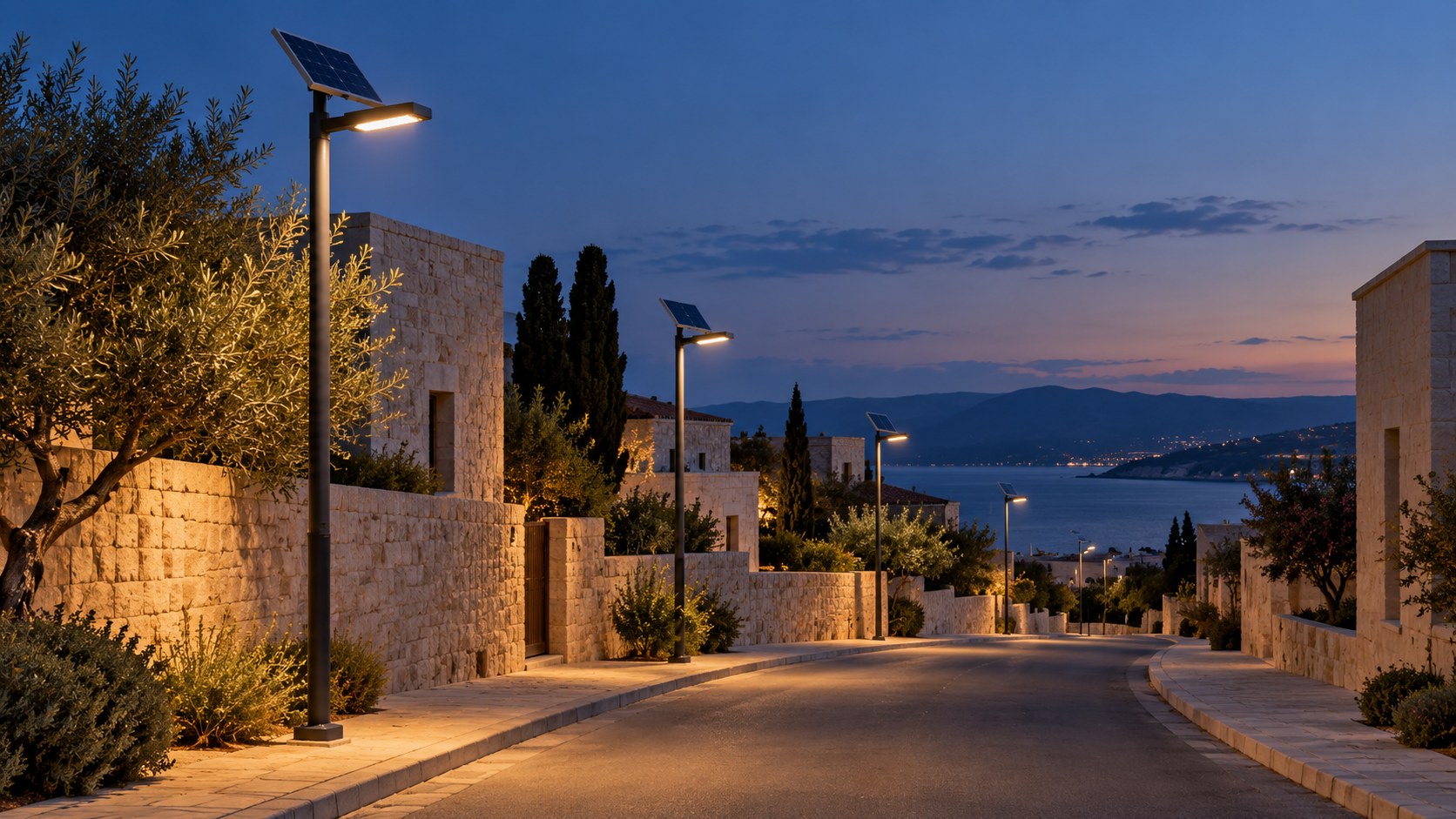
Solar street lights illuminating a roadway in Gaza for municipal and public infrastructure projects
Illustrative image · صورة توضيحية

Overview

Solar street lighting sourced to project specifications.

Virelia does not manufacture solar street-lighting equipment. We work with established manufacturers and suppliers to source systems against client specifications, BOQs, required lighting performance, applicable standards and delivery schedules. Our established base in Deir Al-Balah, Gaza supports local coordination backed by international sourcing.

Depending on project scope, Virelia can coordinate technical review, sourcing, procurement, logistics, delivery, installation, commissioning, training, warranty coordination and after-sales support, giving institutional buyers one accountable project partner.

Scope Virelia can coordinate

10 stages

Pre-procurement

  1. 01Specification Review
  2. 02Sourcing
  3. 03Procurement

Supply & deployment

  1. 04Logistics
  2. 05Delivery
  3. 06Installation
  4. 07Commissioning

Operation

  1. 08Training
  2. 09Maintenance
  3. 10After-Sales Support

Solutions

This page focuses specifically on solar street lighting for roads, municipalities and public infrastructure. For complete solar power systems and battery-storage applications, use the parent Solar Power & Lighting page.

For roadway projects, the core solution families are integrated solar street lights and split-system solar street lights, selected against the issued specification and site requirements.

The preferred configuration depends on maintenance strategy, component accessibility, pole arrangement, autonomy and the client's technical schedule.

Solar street-lighting systems we can supply.

Virelia is not tied to one street-light manufacturer. Systems are sourced to the issued specification, required performance and procurement conditions.

Integrated and split-system solar street lights configured for roadway geometry, required lighting performance, autonomy, environmental conditions and project standards.

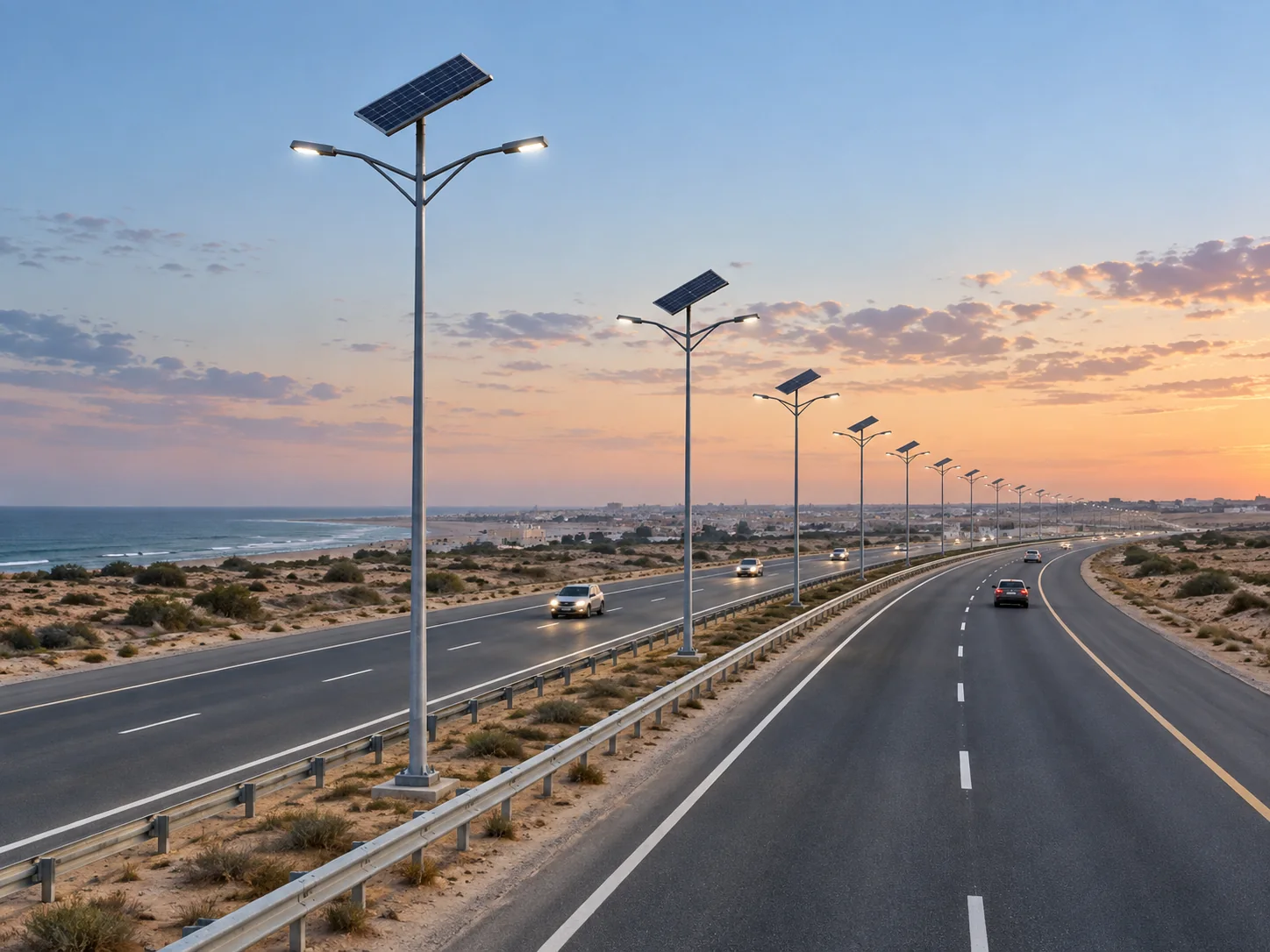
Solar street lights illuminating a freeway for reliable roadway lighting
Illustrative image · صورة توضيحية

01

Street Lighting Systems

Integrated systems simplify assembly, while split configurations can provide more flexible component placement and service access. The tender requirement determines the preferred approach.

Solar Street Lighting

System selection can use integrated or split configurations depending on the tender specification, maintenance approach, component access, pole arrangement and required autonomy.

Independent lighting for roads, streets and public spaces.

Lighting performance should be defined for the road or public-space geometry rather than selected from lamp wattage alone.

Specified by lighting level, pole height and autonomy so it operates without relying on the grid.

Final sizing should be confirmed against the client's required lighting performance and project conditions rather than copied from a generic street-light package.

Products & systems

Packages can be sourced as complete sets or against a component-by-component BOQ, depending on the procurement structure.

9 items

  1. 01Integrated Solar Street Lights
  2. 02Split-System Street Lights
  3. 03Roadway Lighting
  4. 04Municipal Lighting
  5. 05Poles
  6. 06LED Luminaires
  7. 07Batteries
  8. 08Controllers
  9. 09PV Modules
Discuss a Street Lighting Project →

Technical capabilities

Configured around project requirements.

Systems are sourced against the parameters of each project. These are the inputs we work from when reviewing a specification or preparing a quotation.

A typical supply scope may include poles, brackets, LED luminaires, PV modules, batteries, controllers, cabling, fasteners and installation accessories, subject to the issued BOQ.

For road projects, the relationship between mounting height, pole spacing, roadway width and beam distribution is central to the lighting design.

Battery sizing should be linked to required operating hours, autonomy expectations, charging conditions and the selected control strategy.

RefDesign inputConsideration
T-01Power RequirementConnected load and peak demand
T-02Energy StorageRequired autonomy and battery capacity
T-03Solar ResourceSite irradiation and orientation
T-04Site ConditionsRoof, ground or infrastructure constraints
T-05Street LightingPole height, spacing and roadway geometry
T-06StandardsApplicable technical/project requirements

Environmental exposure, corrosion protection, wind conditions and access for maintenance should also be considered when specifying roadway installations.

Virelia can source against client-issued specifications and applicable project standards; no single manufacturer or proprietary system is assumed.

Final configuration is confirmed against the client's specification, site data and applicable standards before sourcing.

For tender-based projects, Virelia can work from the client's BOQ and performance specification rather than imposing a proprietary configuration.

Applications

Typical applications include municipal roads, neighborhood streets, access roads, public facilities, pedestrian areas, parking zones, temporary infrastructure and locations where extending or restoring the electrical grid is impractical.

Where solar street lighting is deployed.

Roads, municipal streets, public spaces and remote facilities can use independent solar lighting where grid extension, trenching or continuous electricity supply is constrained.

Solar generation, battery storage, and power distribution supporting energy resilience
Illustrative image · صورة توضيحية

Energy resilience

This scope covers solar street lights for municipal roads, roadway lighting, neighborhood streets and public infrastructure—not decorative consumer lighting products.

Infrastructure that does not depend on continuous grid availability.

Because each unit operates independently, solar street lighting can also support phased road rehabilitation and public-space programs where grid restoration is incomplete.

Reliable decentralized energy infrastructure is particularly valuable in environments where grid supply is constrained, unstable or unavailable.

Solar street lighting can provide independent roadway and public-space illumination without relying on continuous grid availability.

This makes the solution particularly relevant where reliable public lighting is needed without depending on continuous grid supply.

Gaza · Palestine

From specification to delivery

International sourcing coordinated with local project requirements.

From Virelia's operational base in Deir Al-Balah, Gaza, project requirements can be coordinated locally while manufacturers and suppliers are sourced regionally and internationally. Delivery scope is defined per project and may include procurement, shipping coordination, site transport, installation, testing and handover support.

Installation and civil works are included only where required by the specific project scope; Virelia does not imply a fixed execution package for every supply contract.

One partner across the procurement cycle.

The delivery pathway is designed to preserve the link between the issued specification, the selected manufacturer package, logistics, installation scope and final handover documentation.

A compact, documented process that runs from the client's specification to a commissioned, supported system.

  1. 01

    Requirements & Specification Review

    Technical requirements, BOQ and applicable standards are reviewed and clarified before sourcing begins.

  2. 02

    Manufacturer & Supplier Sourcing

    Qualified manufacturers and suppliers are identified against the specification and delivery schedule.

  3. 03

    Technical & Commercial Evaluation

    Offers are compared for technical compliance, documentation, lead time and cost.

    For street-lighting packages, comparisons can include luminaire output, PV and battery sizing, controller functions, pole specifications, warranty terms, technical documentation and delivery schedule.

  4. 04

    Procurement & Logistics

    Orders, shipping, import clearance and transport are coordinated to the delivery location.

  5. 05

    Delivery & Installation

    Equipment is delivered to site and installed where the project scope requires it.

    Where included in the project, installation scope may extend to poles, foundations, luminaire and PV assembly, electrical connections, testing and handover.

  6. 06

    Commissioning & After-Sales Support

    Systems are tested and handed over, with warranty coordination and support as agreed.

    Handover documentation can include the agreed technical data, warranty documents, inspection or test records and operating guidance required by the project.

Quality, warranty & support

Warranty periods vary by component and manufacturer and are confirmed for the selected package before procurement.

For exposed roadway installations, procurement should also account for environmental protection, corrosion resistance, wind loading and access for future maintenance.

What happens after the equipment is supplied.

For solar street-lighting systems, after-sales planning should consider manufacturer warranty terms, battery replacement cycles, controller and LED component availability, and access for routine inspection.

The intended maintenance model should therefore be considered during component selection, not after delivery.

Quality starts with the specification and continues after handover. The support scope is defined for each project.

01

Quality Assurance

  • Manufacturer selectionEstablished manufacturers and suppliers, assessed per project.
  • Specification complianceOffers checked against the client's technical requirements.
  • Technical documentationDatasheets, test reports and handover records as required.
02

Deployment

  • InstallationArranged where the project scope requires it.
  • CommissioningTesting and handover of installed systems.
  • TrainingOperator training where included in the scope.
03

Lifecycle Support

For long-term operation, maintainability matters: battery access, replaceable LED components, controller access and availability of compatible spare parts should be considered during procurement.

  • Manufacturer warrantyCoordinated under each manufacturer's terms.
  • MaintenancePreventive and corrective maintenance where agreed.
  • Spare partsSupplied as defined in the project scope.
  • Technical supportA point of contact for technical questions after delivery.

Warranty terms follow the conditions of each manufacturer. Installation, maintenance and training are provided where included in the project scope.

Request for quotation

What to define before requesting a solar street-lighting quotation.

Road geometry, lighting performance, pole arrangement, autonomy, battery chemistry, structural requirements and applicable standards all affect the final system. Virelia reviews these inputs before sourcing so quotations can be compared on a like-for-like technical basis.

The result should be a clearly defined, comparable street-lighting package rather than a catalogue-based product selection.

Useful tender inputs include pole schedules, road or site drawings, illumination requirements, operating hours, minimum autonomy, component standards, warranty requirements, installation scope and delivery location.

For municipal road, public-space or infrastructure lighting, send the available BOQ, drawings, pole schedule, lighting criteria and delivery requirements.

Planning a Solar Street-Lighting Project?

Suitable enquiries include municipal road packages, neighborhood street lighting, public-space lighting, access-road lighting and humanitarian or recovery infrastructure programs.

Send us your roadway or municipal lighting requirements, technical specifications, BOQ or tender documents. Our team will review the road geometry, lighting requirements, system configuration, sourcing, logistics and project-delivery scope.

The more complete the specification, the faster manufacturers can be compared for compliance, lead time, warranty and commercial terms.

  1. 01Scope & specificationsTechnical requirements, BOQ and applicable standards.
  2. 02Site & delivery locationLocation, site conditions and any access constraints.
  3. 03Timeline & tender documentsSubmission deadline, required delivery date and RFQ files.

Include the project BOQ or technical schedule whenever available so we can source against the exact procurement requirement.

Submit an RFQ →Contact Our Team